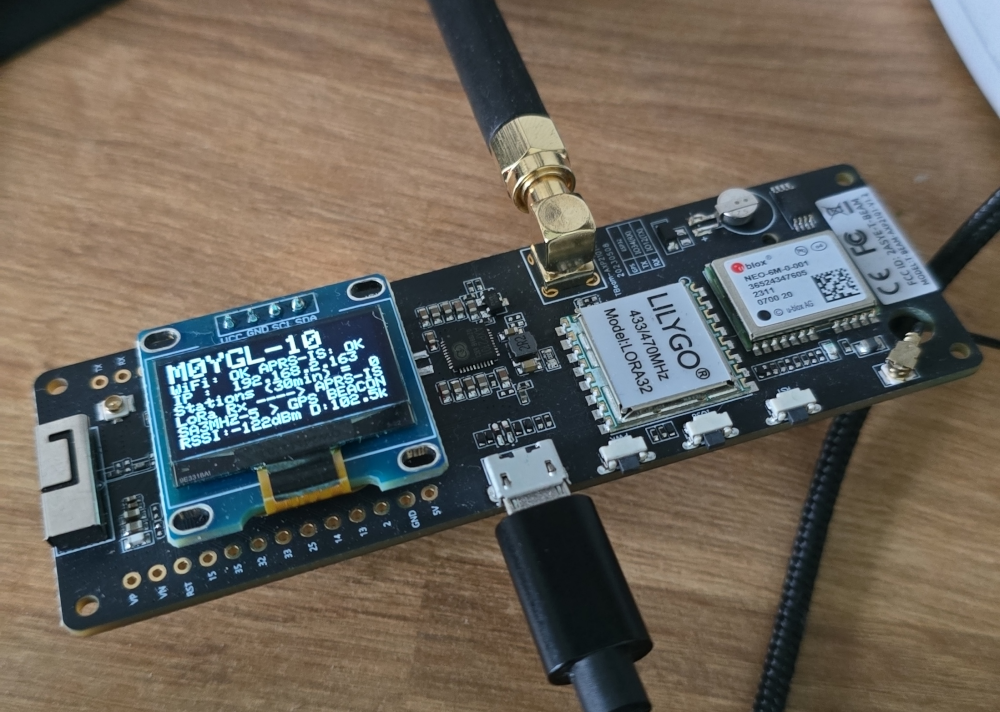
A couple of months ago, I ordered a LilyGo T-Beam (433 MHz) with the intention of joining the RSGB LoRa Balloon Challenge. Unfortunately, from my QTH in Bletchley, things didn’t go quite to plan — the balloon took off and headed north toward Skipton, leaving me well out of range.
After the challenge, I decided to repurpose the T-Beam as a LoRa APRS iGate. Ever since, it’s been quietly running on my desk, using nothing more than the factory-supplied antenna. For weeks, it didn’t seem to hear a single packet. It wasn’t even beaconing to aprs.fi, which I eventually traced to a configuration issue. The silence on the receive side, though, was probably down to the less-than-ideal antenna setup.
Fast-forward to 16 October 2025, and to my complete surprise, a callsign suddenly appeared on the T-Beam’s display: SA3MHZ-5. A quick lookup on QRZ.com revealed the operator as “Mister Morgan” (SA3MHZ) from Sweden.
For a brief moment, I thought I’d stumbled upon some extraordinary DX — especially since we’d just experienced a fantastic weekend of VHF/UHF lift from Friday 10th to Monday 13th October. On that Sunday, I’d even heard a Didcot station working another in the Isle of Man simplex on 70 cm — about 225 miles apart! Naturally, I was curious: how on earth had my modest iGate picked up a LoRa packet from SA3MHZ-5?
Digging into aprs.fi and QRZ, I soon discovered that SA3MHZ operates between Trondheim and Costa Blanca. There were also numerous iGates in Spain reporting packets from SA3MHZ-5. The track suggested something airborne — and sure enough, after checking FlightRadar24, I found my answer.
A flight — Norwegian Air D85332 from Alicante to Bergen — had passed directly over Central London during the same time window that my iGate received those packets. The first packet arrived at 06:42, when the aircraft was somewhere west of Westcott and south of East Horsley; the final one came in at 06:55, by which time the aircraft was north-west of Colchester. The plane was cruising at 38,000 ft the entire time.
So, no miraculous tropospheric ducting this time — but still a remarkable example of how well LoRa performs over long distances and under challenging conditions. Considering the packets were transmitted from inside a pressurised cabin, received by an indoor iGate with the stock antenna surrounded by solar panels, the result is impressive.
It just goes to show that even a simple LoRa setup sitting on your desk can still pull in signals from the sky — quite literally.
Leave a Reply